E-commerce fulfillment is everything that happens between the moment a customer clicks “Buy Now” and the package arrives at their doorstep. While it’s invisible to customers, for online retailers it determines delivery times, reviews, and repeat purchase rates. In this article, we explain what fulfillment entails, how the process works, and when it’s worth outsourcing it.
What does e-commerce fulfillment mean?
The term “fulfillment” comes from English and means “fulfillment”; it refers to the fulfillment of a customer’s order. E-commerce fulfillment (also known as e-fulfillment) encompasses all the logistical steps necessary to ensure that an online order reaches the customer, including returns.
The Fulfillment Process in 6 Steps
1. Goods Received
Your goods arrive from the supplier, manufacturer, or by container at the warehouse. They are counted, inspected for damage, and entered into the warehouse management system (WMS).
2. Storage
Each item is assigned a specific storage location. The system knows at all times how much of each item is in stock and where it is located. These inventory levels are synchronized with your online store so that you don't sell anything that isn't in stock.
3. Order Submission
An order placed in the online store is automatically forwarded to the warehouse via an interface, without any manual intervention.
4. Picking
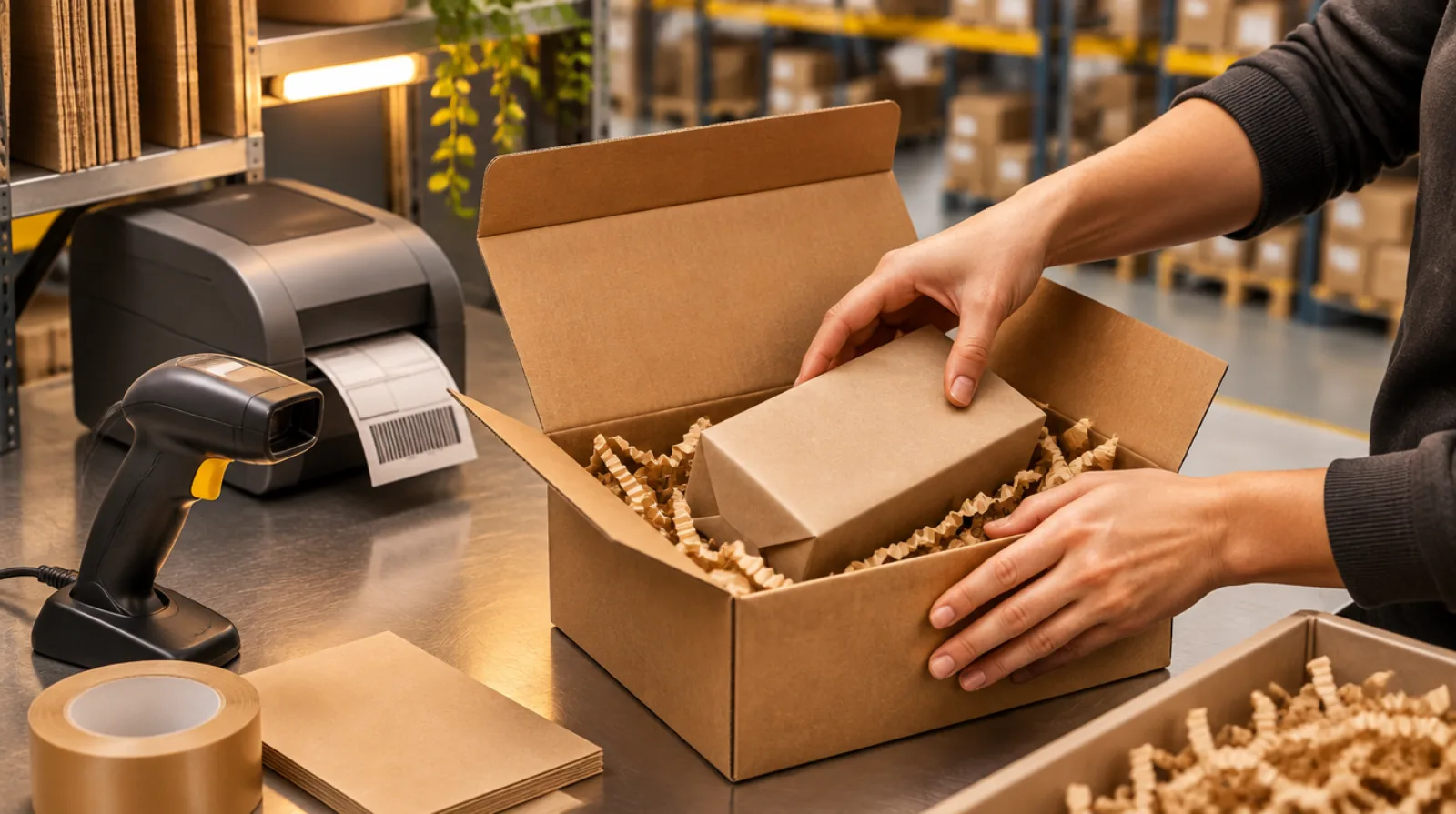
An employee retrieves the ordered items from the warehouse. Barcode scans ensure that the correct items, in the correct quantities, are placed in the package.
5. Packaging and Shipping (Pack & Ship)
The items are securely packaged for shipping, with your branding, flyers, or samples included upon request. The shipping label is generated, the package is handed over to the carrier, and the tracking number is sent back to the store, which then notifies the customer.
6. Returns Processing
If a package is returned, the merchandise is inspected; if it is in good condition, it is restocked, and the store is notified so that a refund can be processed. For more information, see the article “Return Processing for Online Stores.”
In-house warehouse or fulfillment service provider?
| In-House Warehouse | Fulfillment Service Provider | |
|---|---|---|
| Fixed Costs | Rent, Staff, Software, Supplies | Payment per Service |
| Scaling | limited by space and staff | Peaks are smoothed out |
| Shipping Rates | Individual Rates for the Store | Often better terms due to volume |
| Control | entirely in-house | About the Portal and Contact Persons |
| Time required | high | low, focus on sales |
When is outsourcing a good idea?
Typical signs that it's time to bring in a fulfillment partner:
- Packing and shipping take you several hours every day.
- The storage space in the office, basement, or garage is bursting at the seams.
- During sales or peak season, you won't be able to keep up with shipping.
- Items shipped to the wrong address and delayed packages lead to poor reviews.
- You want to sell to Switzerland, but you're based abroad.
How much does e-commerce fulfillment cost?
The costs generally consist of receiving goods, storage space, order fulfillment per order and item, packaging materials, shipping, and returns processing. The exact amount in each case depends on product size, order volume, and additional services. You can find a detailed overview in our article “Fulfillment Costs in Switzerland.”
E-commerce Fulfillment from Switzerland
EasyShip Fulfillment handles the entire process for online stores from our fulfillment center in Dielsdorf (ZH): receiving, storage, pick-and-pack with same-day shipping, shipping via the postal service, DHL, and DPD, as well as returns. Your store is integrated via interfaces with Shopify, WooCommerce, Amazon, and other systems; you can view inventory and shipments in real time in the customer portal. No minimum volume and no annual commitment.
About Our E-Commerce Fulfillment
Frequently Asked Questions
What is the difference between fulfillment and dropshipping?
With fulfillment, you purchase the merchandise and have a service provider store and ship it. With dropshipping, the supplier ships directly to your customer; the merchandise is never held by you or your service provider.
What does 3PL stand for?
3PL stands for Third-Party Logistics, meaning logistics provided by an external third party. A fulfillment service provider is a 3PL that specializes in e-commerce. Learn more: What is a 3PL?
How quickly can a company switch to a fulfillment service provider?
That depends primarily on how your store is integrated and how your inventory is managed. With standard store systems that have pre-built interfaces, this process is significantly faster than with custom systems.
Passende Leistung